1953 -
Forrest Myers’ works hold their own space and, aside from their
obvious conceptual inventiveness, have an inherent integrity of form
and clarity of statement. The result is not “art that is about
something”, but “art that is something”. A dichotomous combination of
rigidity and looseness pervades his work – from the sensuality of
their continuous lines to the folded dimensionality he creates from a
single sheet of metal.
A master metalworker whose attention to detail is readily apparent,
Myers achieves an incredible depth of color in his surface paintings
by manipulating the inherent properties (iron and copper oxides,
cobalt, etc.) of the metal itself. In 1958 Myers began his studies at
the San Francisco Art Institute and was greatly influenced by the
work of Alexander Calder and Jackson Pollock. A musician himself,
Myers found inspiration in jazz, especially the work of Ornette
Colman. The two were friends and collaborators, Colman scored one of
Myers experimental films and would play at the Park Place Gallery.
Myers moved to New York in 1961 at a time when new concepts in
sculpture were rapidly outgrowing the traditional gallery. The
solution was what became the most groundbreaking artists’ cooperative
of its time: the Park Place Gallery. Robert Grosvenor, Mark de
Suvero, Tamara Melcher, Ed Ruda, Leo Valadar, Tony Magan, David
Novros, Peter Forakis and Myeres formed core group of artists. After
the Park Place Gallery closed, Myers showed at the newly formed Paula
Cooper Gallery. Myers also became a member of E.A.T. – Experiments in
Art and Technology. Myers and three other E.A.T. artists were
commissioned to design the Pepsi Cola Pavilion at Expo ’70 in Osaka,
Japan.
In 1964, Myers created his first sculpture which transgressed the
boundary between aesthetics and utility – a simple stool ‘Tendu&rsquo
reconstructed to lean elegantly to one side. Myers returned to
furniture in 1980 with an aluminum armchair ‘Cut Out’ and ‘Fold
Chairs’, which were originally designed in 1971. The ‘Fold Chair’ led
to his first one-man show at the Art et Industrie Gallery in 1981.
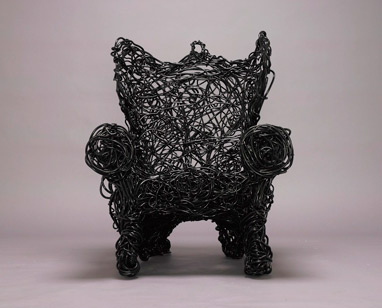
His early influences – jazz and Calder’s wire sculptures - can be
seen in later works made of densely woven anodized wire. In an
interview, Myers commented on these pieces: “I made wire sculpture
thirty years ago […] But using this medium to support human figures,
as sculpture that people can sit on, has only been happening
recently. You may think about something for ten years, and then
suddenly you find yourself doing it without thinking. Being able to
draw so rapidly and then coloring and treating it in so many
different ways is such an open thing for me, it’s like free jazz.”
|