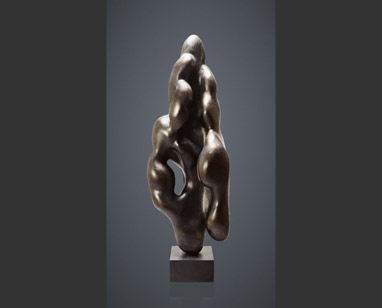
1911 - 2006
During his highly distinguished career, Swiss sculptor François
Stahly received numerous commissions for public works both in Europe
and America, where Nelson Rockefeller was one of his greatest patrons.
Stahly spent his childhood in Switzerland. His Italian father and
grandfather were both painters and strongly encouraged François to
follow in their vocation. Though Stahly did not follow their interest
in painting, he adopted an interest in the arts and attended art
school in Zurich in 1926. At that time, the Bauhaus ideology
dominated the avant-garde. While Stahly was inspired by the
proclamations of a utopian harmony and universal equilibrium, he was
not drawn to the movement’s utilitarian aesthetic. So in 1931, he
went to Paris and attended the Academie Ranson and found a much
broader range of artistic expression. He became part of a group of
young artists called Temoignage, which included Manessier,
Bertholle and Le Moal; unfortunately his work from this period was
lost during the war.
Following the Liberation, Stahly became involved with several
architectural projects while also editing the Swiss art review Werk
and contributing to other magazines. His sculptures began to take on
an organic appearance as Stahly became fascinated by obscure forms
and patterns in nature. He became one of the founders of Art
Informel, which proposed a pure form of expressionistic abstraction.
The group was celebrated in their famous manifesto exhibition in 1948
at Galerie Colette Allendy, “HWPSMTB” (Hartung, Wols, Picabia,
Stahly, Mathieu, Tapié, Bryen). The influential American dealer
Darthea Speyer and the collector H.P. Roche began acquiring his work
and helped him acquire a studio in an old orangery in Meudon.
Stahly also began to establish an international reputation, creating
works in Brussells, Vienna and Berlin (1950); and Connecticut and
Tokyo (1951). He also won several awards including at the Milan
Triennial (1953) and the Sao Paolo Biennale (1957). During the next
few years he spent much time in America working on commissions and
lecturing at universities such as Berkeley, Harvard, and Stanford,
while continuing to exhibit extensively internationally including
Stedelijk Museum, Amsterdam, 1961; Tate Gallery, London, 1964; Musée
d’Art Moderne, Paris 1965.
Stahly refused to sign a contract with any one gallery preferring
to work freely without pressures and demands, which allowed him to
work on a diverse range of projects from a Trappist monastery in
Briquebrac to the Rockefeller Plaza in New York. This unconstrained
creativity continuously stimulated his imagination and produced a
truly remarkable body of work throughout his lifetime that is now
admired in public spaces and museums throughout the world. |